Voyager 1 becomes the first spacecraft to reach one light-day from Earth
Nearly half a century after launch, NASA's farthest probe is now so distant that its radio signal needs a full day to get home.
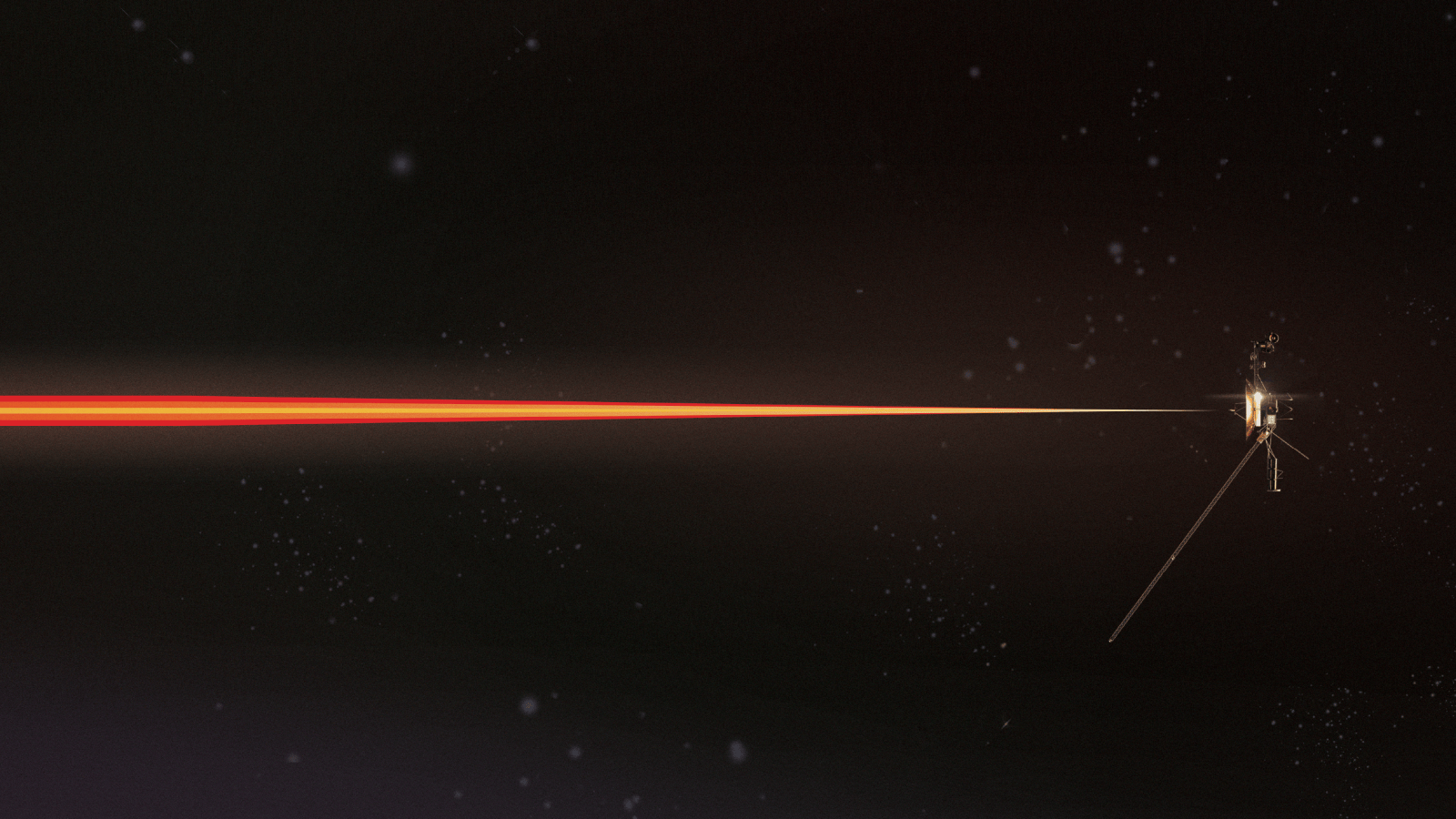
NASA's Voyager 1 has crossed a milestone no other human-made object has reached: one light-day from Earth. The probe hit the mark at 2:16 a.m. PST (5:16 a.m. EST) on Nov. 18, and because its radio signal travels at the speed of light, the team at NASA's Jet Propulsion Laboratory in Southern California heard from it 24 hours later.
A light-day is the distance light covers in 24 hours, about 16.1 billion miles (25.9 billion kilometers). For scale, sunlight passing Earth reaches the Moon in about 1.3 seconds and Neptune in roughly four hours, then needs about 20 more hours to catch up with Voyager 1, which is moving at around 38,000 mph.
“Traveling a light-day is a singular feat for a spacecraft, but Voyager is so much more than a distant traveler,” said Joe Westlake, director of NASA's Heliophysics Division.
There is one wrinkle. The team has not received science or engineering data from the probe since Nov. 14. Voyager 1 is still sending a carrier signal, which engineers combined with trajectory calculations to confirm the milestone, and they are still analyzing the data issue.
Voyager 1 and its twin, Voyager 2, launched in 1977 and flew past Jupiter and Saturn. Voyager 1 entered interstellar space in 2012; Voyager 2 followed in 2018. Both lose about 4 watts of power a year. Earlier this year engineers switched off three devices and swapped in lower-power alternatives, steps expected to keep the science instruments running until at least the probes' 50th launch anniversaries next summer.
Source: This story is based on information from NASA: NASA's Voyager 1 Makes History Reaching One Light-Day From Earth.
Images: NASA/JPL-Caltech, via NASA.